Alabama Law Requires a Pound & Animal Control Officer
The State of Alabama has for nearly a century mandated the impoundment of dogs, cats, and ferrets found running loose without a current rabies tag. As part of this mandate, the local governments in every Alabama county are required to:
- operate an impoundment facility — a pound or a shelter at which to maintain impounded animals
- employ the officer(s) who capture and impound loose untagged animals
- facilitate the owner of the animal the opportunity to reclaim and redeem his lost property.
A Suitable Pound & an Impounding Officer are Required
Pet vaccination, quarantine procedure, rabies tags, and the impoundment of loose untagged animals are required by Alabama law’s Rabies Chapter, which dates to 1935 and 1937, with amendments in 1990 and 2009.
Alabama requires that each county maintain a pound and impoundment officer (ACO) for ‘the protection of man and animals from rabies.’
Cities over 5,000 population, also, must provide or contribute to a pound. The unfunded mandate is found at Alabama Code § 3-7A-7:
Each county in the state shall provide a suitable county pound and impounding officer for the impoundment of dogs, cats, and ferrets found running at large in violation of the provisions of this chapter [without a current rabies vaccination tag].
Every municipality with a population over 5,000 in which the county pound is not located shall maintain a suitable pound or contribute their pro rata share to the staffing and upkeep of the county pound.
Practices at impoundment facilities are regulated by other state laws, including:
- Public pounds and shelters must report monthly on intakes, outcomes, and operational costs. See Animal Census Reports for details, examples, and how to request records.
- Animal Shelter Laws describes conditions for impoundment and seizure of animals, “stray hold,” reclaiming of impounded pets, and sterilization of adopted animals.
Compliance with the State Requirement
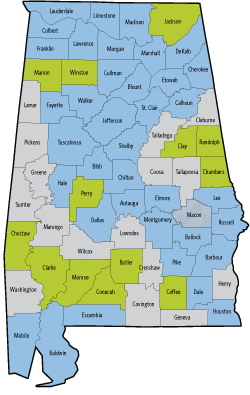
The map at Animal Control & Pounds by County offers a bird’s-eye view of animal services provided in each of Alabama’s 67 counties. Details on those services and other animal-related resources in the county and its municipalities can be found at Your County’s Animal Services.
The map reflects only the existence of a pound and ACO. The statute also stipulates that the pound be “suitable.” The term is not defined, nor are we aware of any related case law. As such, the map does not address suitability of the animal services provided.
A interpretation of suitability might begin with the Act’s stated purpose, “the protection of man and animals from rabies.” We might consider:
- How prevalent is rabies in people and animals in the region?
- Is the county or municipality effectively preventing unvaccinated animals from running at large?
- Are there a substantial number of loose dogs on the streets?
- Does the facility have sufficient resources to care for impounded animals at least for the required hold period?
- Is appropriate operational funding provided by the responsible county and municipal government(s)?
A Public Safety Mandate
Many people equate animal services with animal welfare and expect their local facilities to prioritize positive outcomes for the animals in their care. However, Alabama’s mandate has nothing to do with humane treatment of animals. As such, the state’s impoundment facilities are not required to offer animals for adoption or rescue, coordinate a foster or TNR program, or rehabilitate injured or sick animals. The Rabies Chapter is concerned only with protection from rabies.
Mindy Gilbert, former Alabama state director for the Humane Society of the United States (now called Humane World for Animals), described the situation to Dr. Doug Phillips on the Animal Friends 2 episode of PBS’ Discovering Alabama program:
The mandate has really nothing to do with animal welfare. It has to do with public safety. And even though it has only to do with public safety, still about a third of the state is not in compliance with that.
So to predicate all of the exceptions about how we’re going to respond to animal welfare issues or animal abuse concerns with the shelter or animal control may not be equitable across the board. We have some pockets of the state that have wonderful services available in support of the community and their animals, and we have others that are just black holes of nothingness.
And every community has to evolve this service, this offering, this organization based on community resources, and they differ widely across the state.
Protection from rabies was and remains the stated purpose of animal services in Alabama. The Act was made law at a time when the destruction of ‘stray’ dogs was fueled by fantastical and horrifying tales about rabies.
“To encourage dogs to be rounded up, poundkeepers paid kids 50¢ for every dog they brought to the pound to be killed, no questions asked,” Nathan Winograd reported on Yesterday, Today and Tomorrow: Animal Sheltering in the United States, a podcast series that we consider to compulsory education for every advocate. When impoundment in New York ceased one summer due to a dispute, reformer Henry Bergh sought records for the ‘unprotected’ period — only to find not a single documented case of rabies. Dogs were scapegoated for a disease they were not causing.
Rabies in humans “is nearly universally fatal if PEP is not administered before symptom onset,” according to the CDC. The agency also states that rabies is rare in both people and pets in the United States: “fewer than 10 human deaths are reported each year in the U.S.,” and “rabid dogs in the U.S. are uncommon because of effective rabies prevention and control programs.”
The Alabama Department of Public Health monitors and investigates infectious diseases in Alabama, including rabies. Between January and May 2026, the ADPH reported positive rabies tests for a raccoon, fox, dog, and kitten during the previous five months, and one human exposed. State Health Officer Scott Harris, MD, MPH, warned in October 2025 that “rabies continues to be a public health threat in Alabama,” while UAB Medicine issued a similar alert about this “silent threat.”
If Your Area Lacks Animal Services
Everyone should have an opportunity to reclaim a lost pet, no matter where in Alabama they live, even if there is no shelter. Good Samaritans should be able to help an animal without being required to pay an impoundment fee for an animal they do not own, without being charged with theft of property, and without being told their only choice is to keep the animal or that because they offered the animal food they now own the animal — there is no basis for such a claim in Alabama law.
When ACOs or law enforcement officers instruct residents not to assist loose animals, this instruction creates issues with both public safety and humane treatment, since rarely does an animal stay in place long enough to be impounded. Good Samaritans should not be penalized for doing the job of the city or county.
Shelters that refuse to impound dogs found running at large, that refuse kittens or cats, or that require a resident to pay a fee to bring in a loose animal are promoting abandonment (which is illegal when done by the public) and are failing in their public safety mission.
If your area has no animal control officer and no animal shelter, contact the office of the law enforcement official in charge (i.e., the sheriff or chief of police) to ask how you can get help. You can also speak to your county commissioner or your city or town mayor or councilmember so they know what is happening.
This insufficiency of animal services has been allowed to continue for nearly a century in part because the state does not fund or enforce the mandate. Meanwhile, two rural counties have found innovative solutions, as shown below.
Affordable & Effective Shelter Facilities
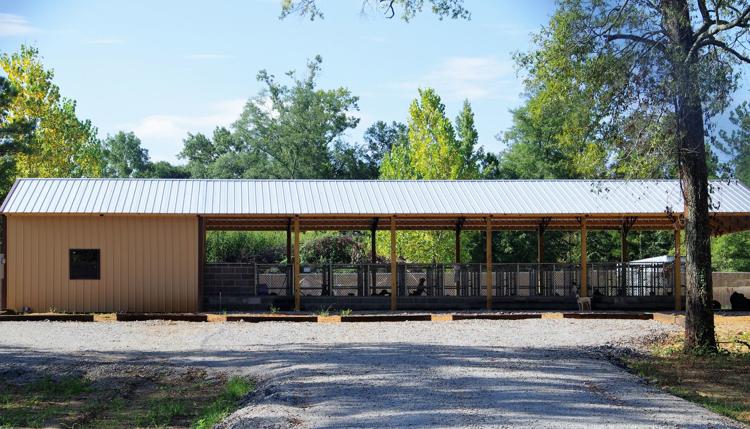
Lawrence County Animal Shelter, shown above, offers an excellent example for the rural areas of Alabama where an animal shelter may seem out of reach. The 26-kennel facility can be scaled up or down to accommodate a range of needs and budgets.
Designed by Commissioner Bobby Burch, Lawrence County Animal Shelter was built for less than $100,000, including $85,000 from a government grant. A pole-barn construction with drains on the sides, the facility has barn curtains which can be lowered for protection from the elements or raised for fresh air. An overhead gas heater keeps the facility above 40°F when outside temperatures fall below freezing.

Hale County approached Auburn’s Rural Studio for assistance in the design and build of their animal shelter, according to Rural Studio's showcase of the Hale County Animal Shelter project. Students Jeff Bazzell, Julieta Collart, Lana Farkas, and Connely Farr designed, fundraised around $100,000, and built the open-air structure, completing the project in 2006. A heating system is incorporated into the concrete floor to keep animals warm during the winter, according to RuralSWAlabama.org. (Photo by Timothy Hursley.)
Additional shelter design and budgeting resources:
- Shelter Design from Humane World for Animals
- Shelter Design Packet (PDF)