Enforcement of Animal Laws
Cullman County’s Proactive Approach
For over 50 years, Alabama counties have faced a conundrum in which their animal control officers (ACOs) are charged with the protection of public safety and animal welfare as prescribed by state laws, yet have no direct authority to enforce those laws.
Cullman County has nimbly tackled this challenge. First, the county invoked a little-known law to extend law enforcement authority to uncertified officers. When that route proved to have its own issues, ACOs instead utilized the state’s Complaints protocol, available to all civilians but typically used only in a non-official capacity, to bring charges for animal-related violations. Cullman County involved the District Attorney’s office to ensure that such Complaints could be effectively prosecuted. Now, recognizing the importance of thorough training and law enforcement authority, the county is making the commitment — apparently unprecedented in Alabama, at least at this scale — of certifying its ACOs in both law enforcement and animal control.
Cullman County’s 35 years of assertive resourcefulness offers multiple paths by which Alabama counties may improve the effectiveness of their animal control program.
Cullman County’s Extension of Law Enforcement Authority to ACOs
The County’s first efforts of which I am aware occurred at a County Commission meeting on Aug. 10, 1989:

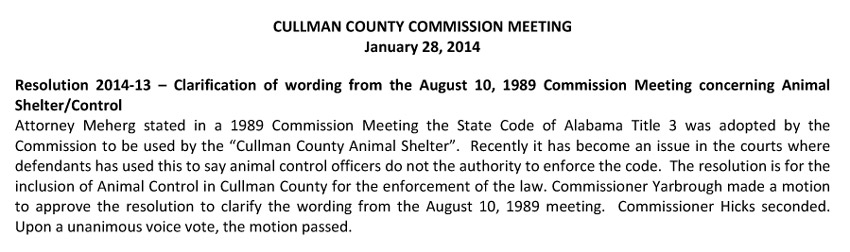
In 2014, the Commission shed light on this nebulous 1989 record by clarifying their intention to grant law enforcement authority to civilian ACOs:
This is the Resolution passed at the same Jan. 28, 2014 meeting:
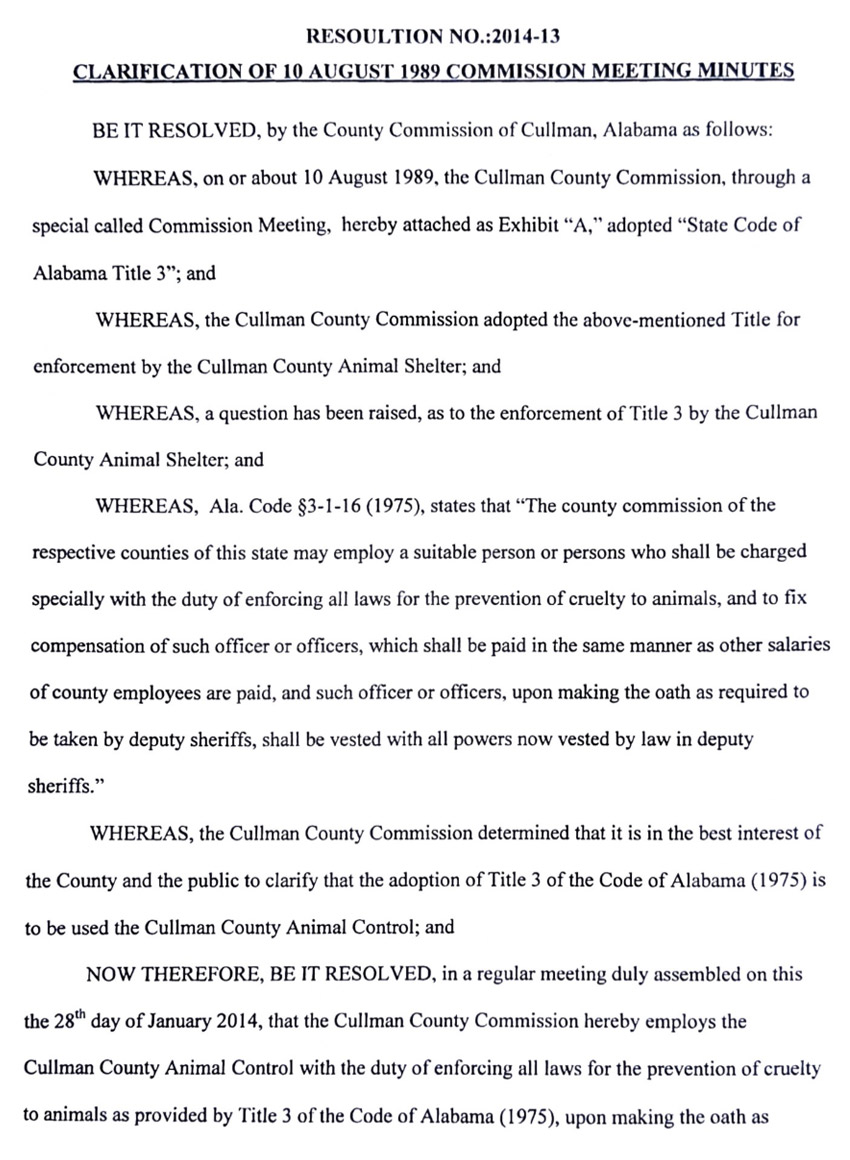
Cullman County Commission resolved to charge their civilian ACOs “with the duty of enforcing all laws for the prevention of cruelty to animals” under § 3-1-16. This 1911 statute remains part of the Code of Alabama even though it was likely abrogated by the 1971 requirement that LEOs be APOSTC-certified.
Challenges to Law Enforcement Authority
While most Alabama ACOs relied on LEOs for enforcement of the state’s animal laws, Cullman County empowered its civilian ACOs to enforce directly. “For a long time, even our ACOs who were not APOSTC-certified were writing citations,” Brad Wilson said during our conversation on Oct. 28, 2025. Brad, who has served as Cullman County attorney since Jan. 2025, was thoroughly knowledgeable of the history of animal control in Cullman County, the efforts being made now, and the obstacles facing animal control programs throughout the state.
One of those problems was — and still is — the overstepping of authority, or in other words, the violation of constitutional rights. Brad pointed to arrests and seizures in Lauderdale County that were thrown out in court because those civilian ACOs lacked the authority to enforce state law. (For similar cases from Colbert County, see WAFF, WHNT.)
Cullman County recognized the perilous legal ground of tasking civilian ACOs with law enforcement duties, even though that authority was apparently allowed by § 3-1-16, and ended the practice at some point after the 2014 resolution.
Now, only the APOSTC-certified Cullman County ACO writes citations. “Civilian ACOs cannot issue citations,” Brad said unequivocably. He explained that when an officer cites a resident for § 3-1-5 or other violation, “in effect you’re making an arrest and giving them a bond, even though it’s an ROR bond.” ROR is an acronym for released on own recognizance. Even though we don’t think of a traffic ticket or other citation as an arrest, “it’s a legal reality,” Brad said.
Complaints Protocol Utilized by Cullman County Civilian ACOs
Cullman County’s other ACOs, who are not yet APOSTC-certified, utilize the state’s Complaints protocol to address violations such as of the dog confinement requirement (§ 3-1-5). “In effect they come up and swear out a warrant, just like any other citizen,” Brad said. If the magistrate finds probable cause, the Cullman County Sheriff’s Office executes the warrant or summons for the owner to appear in court.
I am not aware of ACO utilization of the Complaints protocol in any other county, though I have not specifically researched the topic. To get another county’s take, I checked with Etowah County Circuit Clerk’s Office, where Tammy shared during our Oct. 30, 2025 conversation that the process would be handled just as with any other citizen, e.g., the ACO would come to the magistrate with an Incident Report and evidence, just as Brad had described. She said that she did not recall a county ACO ever doing so in Etowah County; instead, charging was handled by an investigator from the sheriff’s office.
As an example of the value of the Complaint protocol for ACOs, consider a situation in which an ACO witnesses a violation of the dog confinement statute. Even if a LEO hurried to the location, the dog may by that time be out of sight or may have returned to the owner’s property. Since the LEO did not witness a violation in this scenario, he or she could not write a citation. The process is far more efficient if the ACO, who did witness and document the violation, brings the Incident Report and evidence to the magistrate without the need for dispatch of a LEO.
The Complaints protocol also opens a path for civilian ACOs to address misdemeanor and possibly felony cruelty without LEO involvement. Just as pressing charges is a key option for residents when LEOs do not witness the incident or choose not to charge for any other reason, ACOs may also go this route such as when a sheriff’s office does not prioritize animal-related crimes — assuming that county magistrate policy does not, for some reason, bar ACOs or other county agents from asking to press charges.
LEO involvement would still be necessary in situations involving seizure, since civilian ACOs may not seize pets without LEO backing, nor can the Complaints protocol be used in such a way, that I am aware of.
Collaboration with the District Attorney’s Office
Cullman County facilitated a smooth enforcement process by involving all stakeholders: “Lots of back and forth,” Brad said when I recounted Blount County’s challenges in determining how to enforce § 3-1-5. “Anytime you have the potential enforcement of a new law “the best practice is going to the person who is prosecuting the cases to find out how they want to do it: the DA.”
Brad said that as far as he knew, there were no court issues with the county’s utilization of the Complaints process. GBHS CEO Allison Black Cornelius had heard the same when she spoke to Cullman County officials several years ago about enforcement: Allison recalled learning that citations were upheld in court and Cullman County saw a resulting decrease in at-large violations.
Education & APOSTC Certification of ACOs
Cullman County is currently taking another major step to empower ACOs: APOSTC-certification. I am aware of no other county or municipality that has sponsored the certification of its ACO(s).
Animal Control Director Rodney Banister, who oversees three ACOs, said on Oct. 31, 2025 that the second of the three ACOs will complete Academy training in five weeks, and the third begins APOSTC training on Jan. 5 and will finish in April. The other officer was already APOSTC-certified when he was hired by the county a year ago, Rodney said, and is now enrolled in animal control training. The ACOs work for the Commission under the law enforcement authority of the Cullman County Sheriff.
ACO certification is a significant investment for the county, right? Brad answered affirmatively. “It is a hassle for enforcement if you can’t provide help on the ground at the time, so it was worth it for us to have immediate enforcement.”
Brad brought up the potential issue of retention, since APOSTC certification greatly expands the officers’ employment potential. The county has not contractually required the ACOs to stay with Cullman County for any certain term. “We’re trusting them to stick around,” Brad said.
Cullman County Animal Control also prioritizes training in animal control practices and cruelty investigation, favoring education through the Colorado State University-based Code 3 Associates. When training is complete, the three ACOs will be doubly certified: through Code 3’s programs and as law enforcement officers.
Importance of ACO Authority
In many counties, animal control gets little attention or respect. Twenty-nine of Alabama’s 67 counties (43%) have no animal control officers at all, as of this Oct. 2025 writing. Cullman County stands in stark contrast for its decades of prioritization of and commitment to animal control services.
County Attorney Brad Wilson emphasized the critical role of animal control in keeping people safe. “In the [unincorporated] county, especially, it is a huge problem, and enforcement is very important to Cullman,” Brad said, referring to concerns about both livestock and dogs. “So our commission has been really active in making sure all of these issues are taken seriously. It’s been a process, an evolution in Cullman County.”
—
Written by Kristin Yarbrough, with thanks to Michelle Miller for obtaining records and to Allison Black Cornelius for sharing information that led to this research.