Beau’s Law
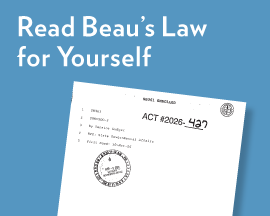
Beau’s Law (Alabama Code § 3-6B-1 et seq.), introduces specific requirements for the shelter, water, food, and the confining, tethering, or chaining of dogs kept outside.

Beau’s Law Requirements
Access to Water, Food, Shelter. Beau’s Law requires that “persons leaving or keeping a dog tethered or confined outside” provide the dog with water, food, and shelter:
- The dog must have “continuous access” to “adequate” potable water, “sufficient” food, and compliant shelter.
- The shelter must be sufficiently spacious “for the dog to stand up, turn around, lie down in a normal position, and extend its limbs.”
- The shelter must be “free from accumulated waste, standing water, and debris.”
- The shelter must be “fully enclosed” and must have a solid floor.
- The shelter must protect the dog from hot, cold, or wet conditions, “including providing shade for the dog and containing bedding for cold weather when necessary.”
Restrictions on How a Dog May be Confined. Dog confinement is required by Running-at-Large (RAL) Laws in many parts of the state. Although Beau’s Law does not require confinement, Beau’s Law does include requirements for dogs that are confined:
- The enclosure must be “secure, fully fenced,” and must provide “adequate space for the dog to freely move around.”
- The dog must have “continuous access at all times to adequate food, water, and shelter” as specified above.
Restrictions on Tethering or Chaining a Dog. Beau’s Law does not prohibit chaining. Beau’s Law does specify how chains and tethers may be used, including:
- The tether or chain must be attached via a trolley system, with a swivel at both ends. Single-point tethering is prohibited.
- The tether or chain must not be “unreasonably heavy in relation to the weight of the dog.” Logging chains are prohibited.
- The tether or chain must be situated to prevent entanglement, injury, or strangulation.
- Choke collars and pinch collars are prohibited.
- The tether or chain must not allow the dog to leave the property.
- The dog must have “continuous access at all times to adequate food, water, and shelter” as specified above.
There are many exemptions to the requirements. The broadest exemption applies to the “temporary” tethering, chaining, or confining of a dog for “a reasonable amount of time with respect to the weather.”
Beau’s Law Became Effective on October 1, 2026 in the state of Alabama.
[Water, food, and shelter: Beau’s Law Section 1(1–2), 2(a)(1)(f), Section 3; confining: Section 2(b); tethering or chaining: Section 1(3)(b), 2(a); exemptions: Section 2(c)(7), 4(2), 4(3).]
Beau’s Law Enforcement & Due Process
Reporting. Suspected violations of Beau’s Law may be reported after Oct. 1, 2026. Reports should be made to the animal control officer (ACO) or law enforcement agency with jurisdiction at the location. Call your area’s dispatch or check your county page’s Animal Control section for specific contacts.
Investigation. Beau’s Law tasks ACOs with investigation of alleged violations of Beau’s Law. Investigation is limited to conditions visible from the street, since ACOs cannot enter private property unless the resident waives Fourth Amendment protection to consent to a warrantless search.
Possible Actions. If probable cause of a violation is found, a law enforcement officer (a sheriff’s deputy, police officer, or APOSTC-certified ACO) is allowed but not required to take either of the following actions:
- Order the owner to rectify alleged violations of Beau’s Law, or
- If the officer “believes the dog’s life is in danger,” the officer may remove the dog, in accordance with the exigent circumstances exception to Fourth Amendment searches and seizures.
Due Process. If the law enforcement officer takes either of these actions, a disposition hearing must be scheduled in accordance with the Pet Protection Act’s procedure. The outcome of the hearing determines whether the animal is returned to the owner.
Beau’s Law Overlaps & Adds Specificity to Existing Cruelty Statutes
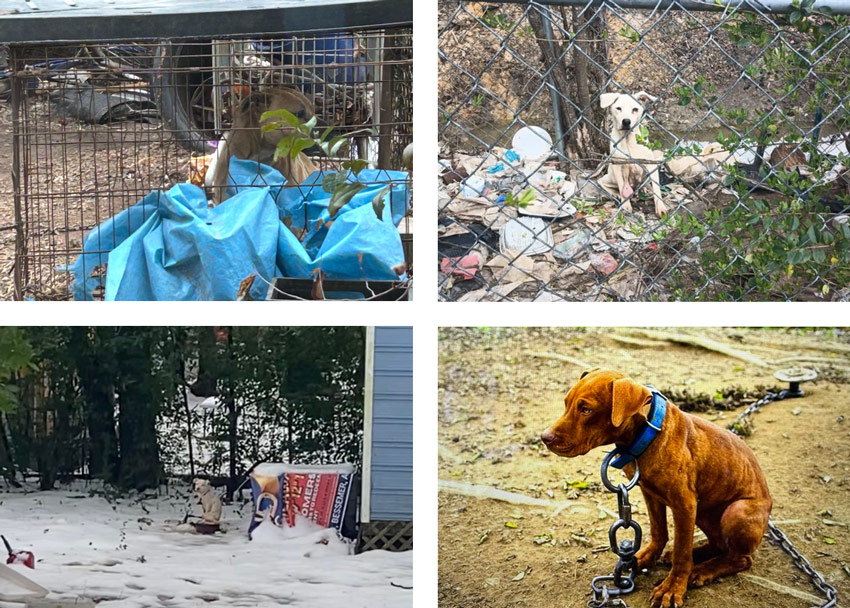
Beau’s Law Overlaps with the Pet Protection Act. Some of the measures in Beau’s Law have already been prohibited in Alabama since the 2000 enactment of the Pet Protection Act. All four of the images above, which were used to promote Beau’s Law, depict acts that were already prosecutable under the Pet Protection Act as more severe offenses.
The Pet Protection Act requires shelter:
A person commits the crime of cruelty to a dog or cat in the second degree if he or she… deprives of necessary… shelterThe Pet Protection Act requires food and water:
A person commits the crime of cruelty to a dog or cat in the second degree if he or she… deprives of necessary sustenanceThe Pet Protection Act prohibits heavy chains:
A person commits the crime of cruelty to a dog or cat in the second degree if he or she… overloads
Responsible law enforcement officials and animal control personnel have for decades made cases regarding companion animals using the laws in the criminal code by articulating how the law was violated, setting the stage for prosecution of those cases and adjudication in the courts.
There are certainly authorities who chose not to investigate or enforce these laws, sometimes by claiming the laws are not clear, and cases in which prosecution is not a priority. Enforcement will be determined by each jurisdiction as it prioritizes cases. Advocates should also be mindful that Beau's Law repeatedly uses the word may instead of shall.
Increased Specificity. Beau’s Law introduces statewide specifications for the shelter, water, food, and tethering or chaining of dogs kept outside. Previously, such specificity featured only in municipal ordinances (Arab § 3-15, for example), while the remainder of Alabama was governed in general terms by the Pet Protection Act (§ 13A-11-240 et seq.).
Co-Sponsor Rep. Phillip Ensler stated that the specificity was necessary:
There are aspects of [existing animal cruelty laws] that are rather vague. So law enforcement wanted an additional law that would help them enforce that. So this is complementary to that, and they can use either. — Rep. Phillip Ensler (House District 74, Montgomery County), as reported by Mike Cason on AL.com.
Other legislators and officials viewed Beau’s Law as a duplication of existing cruelty laws:
People that had issues with [Beau’s Law] worried that we already have existing animal abuse laws. There’s DAs out there that said we already can regulate this now. — Rep. Jennifer Fidler (House District 12, Baldwin County), at a Fairhope town hall.
Beau’s Law Reduces Penalties for Animal Crimes
At the time Beau’s Law was enacted, no form of animal cruelty in Alabama was punishable as less than a Class A misdemeanor. Class B misdemeanor charges had been eliminated in 2013.
Beau’s Law introduced a Class C misdemeanor penalty. The overlap of offenses means that officials will choose how to charge and prosecute violations, with the choice of statute(s) determining the available penalty:
| Pet Protection Act | Cruelty to Animals | Beau’s Law | |||
|---|---|---|---|---|---|
| § | 13A-11-241(b) | 13A-11-241(a) | 13A-11-14 | 13A-11-14.1 | 3-6B |
| applies to | any dog or cat | any animal | dogs kept outside | ||
| offense | Class A Misdemeanor |
Class C Felony |
Class A Misdemeanor |
Class C Felony |
Class C Misdemeanor |
| fine | $0–6,000 | $0–15,000 | $0–3,000 | $0–15,000 | $0–500 |
| prison | 0–1 year | 1–10 years | 0–1 year | 1–10 years | 0–3 months |
Beau’s Law increases to a Class B Misdemeanor for a second violation and Class A Misdemeanor for a third or subsequent violation.
First offenses charged under Beau’s Law will be a Class C misdemeanor. Because this level of crime is so low and resources are limited, prosecutors may choose to not handle Beau’s Law cases.
Montgomery Humane Society (MHS) Director Steven Tears discussed the implications of the reduced penalty in the MHS’s summer 2026 newsletter:
Under existing law, the MHS has been able to successfully prosecute cases by holding offenders accountable in a meaningful way. Beau’s Law, however, reduces certain first-offense violations from a Class A misdemeanor to a Class C misdemeanor, effectively lowering the consequences for actions that cause real harm to animals. For my Animal Control and Humane Officers, who work daily to ensure our community's animals are being treated humanely, this is not a negligible reduction. It is the difference between real accountability and a slap on the wrist. When the penalties undergirding our laws lose strength, so does the law’s ability to protect.
Challenges to Enforcement & Prosecution of Beau’s Law
Many Alabama counties and cities lack the necessary infrastructure. In cities and counties with no animal control, who will investigate? In cities and counties with no animal shelter, will dogs be left amid life-threatening conditions because there is nowhere to take them?
[T]his legislation creates an unfunded mandate on our rural counties. Many of these communities simply don’t have the financial resources, personnel or infrastructure to enforce these new requirements effectively. On top of that, many rural counties don’t have adequate animal shelters — so if dogs are taken, where do they go and what will ultimately happen to these dogs? That’s a serious question that hasn’t been clearly answered. — Rep. Steve Clouse (House District 93, Dale and Houston counties), via Facebook.
We don’t have a leash law in the county, and I don’t have canine enforcement officers. We don’t have laws that pick up dogs when they run at large*, so, yeah, it’s going to be difficult. Our officers will have to go to each situation and work through it 100 percent. It’s going to be complicated, but at the end of the day, it is a law for the animals. — Coffee County Sheriff Scott Byrd, via WTVY. [Actually, Coffee Co. does have a law, as does all of Alabama: § 3-7A-7.]
In rural areas, this law is going to get a lot more complicated than easy. It’s going to be really hard for these departments to actually enforce this law, just for the sheer fact that there are so many counties in Alabama that do not have shelters. There are so many small towns that do not have animal control. So, there’s going to have to be some state funding. There’s going to have to be people to put animal sheltering on the front lines of laws. — Tiffany Howington, Troy Animal Rescue Project, via WSFA and WTVY.
Enforcement of Alabama animal laws is already lacking. Even while cruelty crimes are felony and Class A misdemeanor offenses, law enforcement agencies have avoided involvement, as explained above by Rep. Colvin. With the enactment of Beau’s Law, offenses will be downgraded to Class C misdemeanors. Might we expect this reduction to prompt more or less law enforcement involvement?
My concerns with the legislation outweighed even the love I have for dogs. I’m worried most issues with animal cruelty is lack of enforcement of current laws. That’s not a criticism of law enforcement, it’s just the reality…. I also just had practical application concerns about private property, probable cause, etc that lead me to eventually vote no. — Rep. Brock Colvin (House District 12, Marshall County), in correspondence with Paws4Change author Aubrie Kavanaugh.
Similarly, prosecution of animal laws is already lacking, and may decline further when acts of cruelty that for 26 years have been charged under the Pet Protection Act as Class A misdemeanors are instead, due to what is called “subject matter overlap,” charged under Beau’s Law as Class C misdemeanors. Because this level of crime is so low and resources are limited, it is possible prosecutors may choose to not handle Beau’s Law cases. This will be decided by attorneys.
Administration of Beau’s Law will vary. Every county, city and town is a separate juriis overlap. In some places the new law may not be enforced at sdiction for purposes of law enforcement and prosecution. That means each county, city, and town will determine how the new law will be enforced related to existing laws since there all. In other places, attorneys determine how all the laws are enforced for that particular jurisdiction, including Beau’s Law. What is decided for Marshall County (which has animal control and shelters in the county and cities) will likely have very little to do with what is decided for Washington County where there is no animal control and no animal shelter.
Some officials view Beau’s Law as government overreach. Alabama is of two minds when it comes to treatment of companion animals, Aubrie Kavanaugh explained on Paws4Change and in Not Rocket Science. One of those mindsets is demonstrated in this statement: “You can say my wife is ugly and my kids are stupid, but don’t tell me how to treat my dog.” Rep. Easterbrook expressed a similar view during the final House debate over Beau’s Law:
I think it is ridiculous that with all the crime that we have on the human side, here we are talking about putting people in jail over a damn dog. It’s ludicrous to me, and the idea that they have to have a wooden floor… are we gonna build condominiums for dogs? — Rep. Brett Easterbrook (House District 65, Baldwin, Choctaw, Clarke, and Washington counties), on the House floor, apparently unaware that people already go to jail over animal crimes. Of those four counties represented by Easterbrook, Choctaw and Clarke have no animal control officers, while Washington has neither animal control nor an impoundment facility, in violation of Alabama law.
I ultimately voted against this bill because I have real concerns about how it impacts responsible dog owners, particularly in our rural communities. I heard from just as many people who had serious concerns about this bill as I did from people who supported it…. The bill also also requires that structures have a floor. In many rural areas, dogs have access to dog houses, barns or shelters without a traditional floor and are still well cared for. Should those responsible dog owners be subject to arrest? That’s a real concern with how this bill is written.… We can — and should — protect animals from abuse. But we also have to make sure we’re not placing unnecessary burdens on responsible owners, infringing on property rights or creating laws that don’t fit the realities of rural Alabama. — Rep. Steve Clouse (House District 93, Dale and Houston counties), on Facebook.
Officers are not trained on animal law. Alabama has animal protection laws that have been in place for decades, many of which are neither enforced in the field nor taught at the APOSTC academies or as part of annual continuing education: our understanding is that bestiality law is the only animal law presented during LEO training. Because each jurisdiction will determine how the law is enforced, training for one location will be vastly different than other locations if any training is done at all. It is not a one-size-fits-all subject because of the separate jurisdictions.
Many have commented that the exceptions and conditions written into Beau’s Law render the law unenforceable. As one example, Beau’s Law’s requirements for shelter, water, food, and tethering do not apply during “any temporary circumstance during which tethering or confining a dog is necessary but not exceeding a reasonable amount of time with respect to the weather.” As Rep. Fidler pointed out in her comment quoted below, what is temporary, necessary, reasonable? If a dog owner states that his otherwise prohibited choices were temporary or reasonable, the onus will be on the state to produce evidence demonstrating some measure of permanence and unreasonableness — a hefty burden of proof in any case, particularly for a low priority, low-level violation which carries no required sentence.
I think they’re going to have to revisit it if they really want a law that is going to be enforced in Alabama. They’re going to have to revisit it because if you read it, it’s not enforceable unless you have everything in line and all the stars line up and all the planets line up. I just don’t think it’s enforceable. — Derek Farr, Randolph County Commissioner, School Resource Officer, and Sheriff candidate, in 1819 News.
The people who had issues with [Beau’s Law worried that the law] over-regulated responsible pet owners and used words like adequate, temporary, and reasonable that were hard to define. — Rep. Jennifer Fidler (House District 12, Baldwin County), at a Fairhope town hall.
Cities and towns can adopt and enforce their own laws that protect animals — while circumventing some of the challenges posed by Beau’s Law. Arab § 3-15 is an example of an effective city ordinance. Its straightforward, outcome-focused requirements can be easily communicated and prosecuted. This ordinance has also been adopted by Albertville and is being considered in Florence.
Beau’s Law is an unfunded mandate. Every jurisdiction has finite resources for law enforcement and prosecution, and Beau’s Law allocates no funding.
Most law enforcement agencies prioritize human crime that they deem is the most important to address with their limited resources. Most counties and cities cannot afford to increase their animal control staff. I was worried this bill could be an unfunded mandate on cities and counties. — Rep. Brock Colvin (House District 12, Marshall County), in correspondence with Paws4Change author Aubrie Kavanaugh.
Media/Official Contact
Public officials and reporters are welcome to be in touch. Please email; we are typically able to quickly reply to arrange for a phone call, provide information, or whatever might be needed.