Sylacauga‘s Hwy 280 Dogs ‘Will Have to Wait’
Proposal Approved, GBHS Now Not Available
TRAPPING DELAYS — Although their trapping and darting proposal was approved on July 21, Greater Birmingham Humane Society revealed that the organization is now not available to begin trapping operations. GBHS stated (on p.7) that since providing their proposal on June 16, the organization has
been assisting two other cities with large-scale trapping operations, and Sylacauga will have to wait until those operations are complete before we can assign traps and cameras to the City of Sylacauga.
Since there is a delay, the city should and could reach out to Winston Randle of Wayward Hounds, who for several months has offered to trap for free. Randle also has all of the necessary equipment and believes he could trap 10 dogs on the first day. Why wait for GBHS to get their affairs in order?
Five months have passed, and still Sylacauga has no start date. “If the shelter/animal control had caught only TWO a week since March, there would be zero dogs on 280,” Randle said. “These dogs are not getting the help they need. Time is not their friend.”
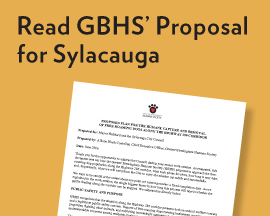
As Sylacauga and GBHS prepare to move forward, we stand by these concerns:
- Contractor Capability: GBHS has neither the expertise nor the equipment, such as missy traps and net guns, to ensure public safety, humane treatment, and timely collection of the dogs, according to experienced humane trapping volunteer Winston Randle, who is still willing to trap for Sylacauaga and has offered to loan his seven missy traps to GBHS, which he states has none. Personnel is also a question, since presumably GBHS will divert their ACOs from contracted service areas to Sylacauga. Time will tell if they can resolve this issue for both the short and long term.
- Chemical Capture: GBHS’ proposal includes the use of chemical capture (darting) of dogs that evade traps. Randle and fellow trapper Jasmine Lawson on May 21 urged Sylacauga leaders to avoid darting of loose dogs, which they characterized as dangerous for both dogs and people — and unnecessary, since a competant trapping effort would not require darting.
- Public Safety: A dog hit by a chemical dart can “run til it explodes its heart to get away from the pain,” Randle said, explaining that there is no way to prevent darted dogs from entering Highway 280 and endangering drivers. The use of darts on loose dogs would unnecessarily and negligently jeopardize public safety, according to Randle.
- Liability: A city requires contractors carry liability insurance against financial risks. GBHS’ proposal instead requires Sylacauga to assume liability for GBHS’ actions. “If GBHS darts a dog and the dog runs onto 280 [resulting in harm to drivers], Morgan & Morgan will own Sylcauga,” Randle explained. “You cannot buy enough liability insurance for what a jury will award for a negligent death.” The use of chemical darts on loose dogs near the 280 is “not worth the risk,” Randle said.
- Mayoral Bias: Although city leadership has been offered free assistance and guidance since early May from long-time Montgomery Humane Society director Steven Tears and experienced humane trapping volunteer Winston Randle of Wayward Hounds, Mayor Hubbard appears to be again push councilmembers toward the contractor of his choice: first a landscaping company with neither the experience nor the appropriate equipment for humane dog trapping, and now a nonprofit with reportedly the same concerns.
Meanwhile, humane trapping experts continue to freely offer their guidance and equipment to help the City of Sylacauga resolve this issue.
Sylacauga’s ‘Hunt’
Late February or Early March 2026 — The City of Sylacauga received a formal complaint sent on behalf of Publix’s management company, Hutton Management of Chattanooga, regarding loose dogs on their property.
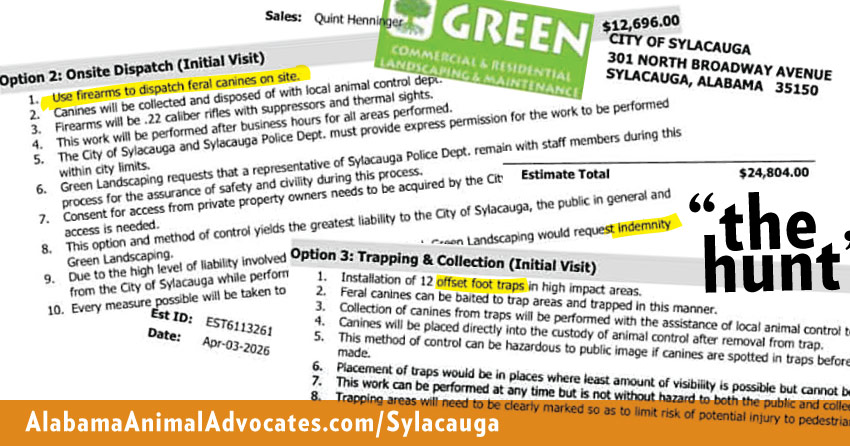
May 5, 2026 — Sylacauga Mayor Matt Hubbard and Police Chief Rondell Muse surprised City Councilmembers and residents alike by unveiling a plan and pushing a same-day vote regarding the 15-20 loose dogs living in shopping center parking lots and grassy areas along the 280 corridor. Their proposal, prepared with Green Landscaping, featured:
- fatal “dispatch” of the dogs after shopping center business hours with .22 caliber rifles with suppressors and thermal sights
- a requirement that the City of Sylacauga provide indemnification and police presence during what Chief Muse referred to as “the hunt”
- live capture via foothold traps, a method banned in 101 countries and 10 states as inhumane
Councilmembers were asked at that meeting to allocate $24,800 to trample Alabama’s animal cruelty law and administrative code — violations that neither Chief Muse nor City Attorney Win Livingston publicly addressed. “Are they weed eaters by day, dog snipers by night?” wondered Sylacauga Councilmember Laura Barlow Heath, who cast the lone vote against the budget allocation, blocking the Mayor from moving forward that evening. Meanwhile, Councilmember Nate Brewer enthusiastically endorsed what Sylacauga Police Chief Rondell Muse termed “the hunt” of dogs living in shopping plaza parking lots bordering Highway 280. “I fully support everything in this packet,” Brewer said. “I fully support Option 1, 2, and 3.”
In the following days, Councilmembers Laura Barlow Heath and Tim Vincent expressed substantial concerns over the proposal. “This is just going to mask the problem,” Vincent said. “It’s not going to fix it. We gotta come up with some issues or some way to stop this from recurring. We can’t go euthanizing dogs, shooting dogs every year.” Vincent, who described himself as a dog rescuer, voiced strongest objection to foothold traps. “Option 3 to me is the worst option,” he said. On May 7, Vincent addressed the topic on Facebook, stating, “I cannot support solutions centered around aggressive trapping or shooting of these animals as the primary response to this issue.”
On May 7 and May 12, as detailed below, Mayor Hubbard claimed he does not support shooting dogs. On a May 19 Facebook reel, Hubbard seemed to state that the shooting option in the proposal will not be considered.
May 21 — At this meeting, two private citizens shared their trapping experience and offered pro bono assistance to the city. The Sylacauga City Council then resumed discussion of the challenges faced by its shelter and animal control. And Councilmembers learned that once again Mayor Matt Hubbard had been in talks without Councilmembers’ knowledge (1h32m). This time the talks were with Greater Birmingham Humane Society (GBHS), the Jefferson County pound contractor that has since 2025 been withholding its animal outcome reports in violation of Alabama law.
Jefferson County residents Winston Randle of Wayward Hounds and Jasmine Lawson shared their experience trapping elusive dogs with missy traps and offered free assistance to the city. Randle (at 24m30s) and Lawson both spoke about the dangers posed by chemical capture — to dogs, to the public, and to personnel.
Winston Randle “is a very knowledgeable man, and he’s passionate,” Councilmember Heath said on Daybreak. “That’s the difference. When you have somebody in that role — a volunteer, who is passionate about it — you know it’s going to work.”
June 2 — GBHS CEO Allison Black Cornelius presented to Sylacauga City Councilmembers. Following an introduction, Cornelius addressed (at 1h42m) the “wildlife management situation” in Sylacauga, stating that GBHS would do “recon” and then submit a proposal in which feeding is diverted to areas away from the 280 and then multiple traps dropped simultaneously, with missy traps utilized for any remaining dogs. Cornelius stated that her proposal would include darting (1h52m). There will be no “fiscal note” on the proposal, Cornelius explained, stating that “whatever you decide to pay if we're successful is up to you.”
June 16 — Councilmembers discussed the proposal from Greater Birmingham Humane Society (GBHS) which they had received that day. Council President Tiffany Nix stated that councilmembers would take the proposal home to review.
July 7 — Although the meeting agenda included discussion and a vote on GBHS’ proposal, the item was postponed until July 21 because GBHS representative(s) could not attend or call in to this evening’s meeting to clarify questions about the proposal. Councilmember Laura Barlow Heath commented today at 7:18 p.m. in a private Facebook group:
This will be voted on next meeting. The GBHS could not be in attendance to answer questions concerning their proposal we just received. I have around 30 questions I am submitting to the mayor by tomorrow for them to answer. I did not feel comfortable on blindly voting without my questions being answered.

July 21 — The council approved GBHS’ proposal 3:2, with Councilmembers Heath and Vincent opposed. In a 10-minute discussion of the related ordinance draft, City Attorney Win Livingston stated that the applicable animals had been changed from dogs, cats, and pigs to “feral dogs” and that the coverage area would be limited to the 280 corridor businesses, as had been originally stated, rather than the entire city. A written warning would be issued on the first violation, with fines of $200, $300, and $500 and possibility of jail time for subsequent violations. Council President Tiffany Nix stated that the city is required to advertise the ordinance draft for 10 days and hold a public hearing. Nothing was said about the 30+ questions Heath and Vincent had submitted two weeks ago, nor were GBHS' responses shared by the city. We share GBHS' responses here thanks to a confidential source.
Aug. 5 — Notes will be added as soon as we are able. Discussion of animal topics continues through 1h22m.
Thanks to Paul Stepp for filming and sharing Sylacauga City Council meeting videos, without which this documentation would not be possible.
Why So Many Loose Dogs?
Amid explanations and defenses, several officials acknowledged the years of inaction. Sylacauga Animal Shelter Director Stephanie Engle explained the unsuccessful attempts to trap the dogs.
Decades of Avoiding the Issue: Sylacauga Animal Shelter director Stephanie Engle and Councilmembers Tiffany Nix and Tim Vincent all acknowledged that loose dogs have been a longstanding problem in Sylacauga: “In past years,” Vincent said, “[the city has] just been kicking the can down the road.” Council President Tiffany Nix said, "We've been put on notice… We can’t just keep letting it go on cause it’s just going to get worse.” Residents informed us that the problem has been ignored for at least a decade. “I grew up 10 miles from Sylacauga, left in 1971,” one person wrote, “and never wanted to go back because of the dead dogs that littered the highway between [Sylacauga and Childersburg].” At the May 21 meeting, Vincent described watching a 2016 council meeting to research history of this issue and said the same problems were discussed, same questions asked, and nothing has changed.
The city has “been addressing this issue,” Mayor Matt Hubbard explained, for “four, four-and-a-half months ago maybe,” by attempting to trap the dogs in a Missy Trap constructed and deployed by ACO Brandon Gerrins at the woodline near Publix Super Market, Engle said. Gerrins had successfully trapped six dogs in the Walmart parking lot, Engle explained, but 12–15 dogs remain.
Ineffective Communication: Mayor Matt Hubbard and Shelter Director Stephanie Engle blamed the community for crippling the city’s trapping efforts by feeding the dogs. “We can't get these animals to go into a trap because we’ve had people that feed them constantly,” Engle said at the May 5 Sylacauga City Council work session. Local residents, though, tell us that the city made little effort to inform good Samaritans of the need to pause feeding so that the dogs would seek the food in the trap. Our understanding is that no signage was posted in the area, nor was the message displayed on the city marquee. “I haven’t seen any measures being taken to put up signage in the areas to instruct people not to feed the animals,” Sylacauga resident Ashley Cunningham told Charlize Ramos of CBS42. The only instructions from the city, in our awareness, are Facebook posts by the shelter account dated Dec. 20, 2025 and Mar. 17, 2026. Nix acknowledged the need for signage at the May 21 work session (1:26:23); Hubbard then stated that an ordinance is required to “prevent interfering with a government operation.“
Regional Lack of State-Mandated Animal Services: Mayor Matt Hubbard pointed out the culpability of neighboring counties that lack state-mandated animal services. Even though Alabama requires that every county have a pound and impoundment officer, Talladega County and several other counties in central east Alabama have no pound and no animal control officers. Since dogs don’t know jurisdiction, Sylacauga’s neighbors are contributing to the number of dogs roaming in the city.
- Talladega County has neither an ACO nor a pound. There is no one employed to pickup stray dogs. Sylacauga Animal Shelter is contractually required to accept dogs and cats only from within 3 miles of Sylacauga, a service for which the county pays Sylacauga $20,000/year.
- In choosing not to appropriately fund or operate animal services, Talladega County shifts their responsibility onto other counties and cities. A resident who asked Talladega County for help was told to shoot the dogs, she told the Daily Home, even though harming a dog in the absence of an immediate threat is criminal animal cruelty.
- Sylacauga’s own animal control has been intermittent, with no officer for many months prior to the hiring of ACO Brandon Gerrins in December 2025. Also of interest is that Sylacauga City Ordinance § 4-25 states that loose dogs “may” (rather than shall) be impounded. If the city is allowing dogs to run at large and making no attempt or to impound them or impounding only intermittently, that is a public safety issue. With the Sylacauga Animal Shelter “always full and nowhere for these animals to go,” as Mayor Hubbard told WBRC, Sylacauga lacks capacity to serve their own community, much less also take on the county’s responsibility. Hubbard stated at the work session that Alabama law requires sheltering to be a county [rather than city] operation, a misunderstanding of Alabama Code § 3-7A-7.
- Coosa, Tallapoosa, and Cleburne counties all have no animal control services and no pound, in violation of Alabama Code § 3-7A-7, while Clay, Randolph, and Chambers counties each operate a pound but have no animal control officers.
Region-Wide Choice to Not Require Dog Confinement: Since 1915, each Alabama county has had the option to adopt Alabama Code § 3-1-5, which requires owners to confine dogs to their own premises. Since Emily’s Law (Control of Dangerous Dogs) is applicable statewide, there is no excuse for counties not to adopt § 3-1-5 for public safety, quality of life, and a reduction on the strain on animal services — yet neither Talladega County nor Coosa, Clay, Tallapoosa, Cleburne, nor Randoph County Commissioners have made the simple election to adopt the statute. The inaction of these county governments ultimately affects Sylacauga and every other city in the county. Sylacauga and other Talladega County municipalities do require dog confinement by ordinance, though it is unclear whether these local laws are enforced.
Did Sylacauga Officials Act Transparently?
Sylacauga Mayor Matt Hubbard opted to present his dispatch proposal in a city council work session — a public meeting upon which the document would be public record — rather than at an executive session, where legal matters can be discussed confidentially.
Apparently Hubbard and several other public officials had hoped to consider the proposed capture or execution of the dogs without public scrutiny. Instead, outraged residents fueled the proposal’s circulation on Facebook throughout the morning and afternoon leading up to the 5:00 p.m. meeting. Constituents filled the seats of the meeting room. As he began his lengthy remarks about the last-minute agenda item, which was the subject of more than half of the 90-minute work session, Hubbard mustered no enthusiasm in addressing the “few extra people here.”
“I’m a quiet leader,” Mayor Hubbard explained. “I don’t want to draw attention to things.”
Several officials responded by defending their choices. “At no point in time has this ever tried to be non-transparent or any of that type stuff,” Mayor Hubbard said. “We have not had a secret meeting,” Council President Tiffany Nix promised. “The only reason y’all didn't know about this in the planning stages,” Chief Muse explained, pointing to a news camera, “is because of what’s going on now.”
Had Mayor Hubbard truly wished to be transparent, might he have acknowledged the proposal on the agenda, at the very least? After all, transparency may be defined as the absence of a hidden agenda. And really, wouldn’t true, full transparency mean also providing the proposal PDF along with the agenda, so that constituents could familiarize themselves with documents to be discussed at the meeting?
The proposal’s existence was news even to Councilmember Laura Barlow Heath, who represents the district under discussion. “I was in the dark. I had no idea the meeting had taken place,” Heath said.
While constituents felt blindsighted to learn of the plan only hours before its public discussion, Councilmember Greer Bisignani expressed that it was the council whose trust had been breached by whomever might have shared a screenshot of the proposal that morning. Bisignani opened her written remarks by declaring the council’s care and compassion for animals. “Even more concerning at present is how this document became public,” Bisignani continued. “The release of an internal preliminary proposal before any real council review represents a serious breach of trust. Our process depends on the ability to review, discuss, and refine our ideas before they are presented to the public.” Bisignani asked the mayor to investigate.
Since the public was at that point entitled to view the proposal — as of the meeting, it was a public document — what trust was breached or what process was compromised by the public viewing that document a few hours earlier?
The morning after May 5’s 55-minute discussion of the proposal, Mayor Hubbard commented to Daybreak host Jimmy Dale Abrams that “It’s unfortunate the council did not approve the funding for it last night,” adding that “he’d love to start immediately.” The very next day, Hubbard told WBRC that the proposal had not even been a consideration. A week later, WTVM reported that Hubbard told them “he believes shooting dogs is inhumane and he is fully against it,” stating in interview footage, “As long as I’m mayor, an option like that, that’s never gonna happen. We’re not gonna shoot animals in the city of Sylacauga.”
After Greene Landscaping withdrew their proposal, Hubbard surprised councilmembers again by revealing that he had been in talks with GBHS. In July, a related ordinance (PDF) was presented with substantially different terms than what Hubbard had told the council, Vincent wrote on Facebook.
I have been told repeatedly this proposal would be limited to the Highway 280 commercial area and would address the specific issue of stray dogs in that location. The ordinance that has been presented for consideration does neither. Instead, it applies citywide and includes both dogs and cats. That is not a minor change; it is a completely different policy.
Unfortunately, this is not the first time the Council has been asked to consider legislation without full transparency or with details that differ from what was represented. That is not how good government operates. Council members have a duty to insist that ordinances placed before us accurately reflect the intended purpose. Until that happens, I cannot support this ordinance.
The ordinance was quickly edited prior to the July 21 meeting to limit its scope to dogs in the targeted area. Meanwhile, none of the relevant documents — the Greene Landscaping proposal, the GBHS proposal, either version of the ordinance, GBHS' responses to questions submitted by Heath and Vincent — has been released by the city. All of the documents we share on this page were obtained through confidential sources.
Representative governance is broken when city matters are hidden from the community. As Sylacauga resident Rhonda Housand wrote on Facebook,
Citizens should have the opportunity to speak with their representatives regarding issues BEFORE a vote occurs.
Troubling Legality
The course of action proposed by Mayor Hubbard, Chief Muse, and Green Landscaping appeared to violate Alabama Code § 34-29-132, a statute that allows for the shooting of domestic animals “whenever an emergency situation exists which requires the immediate euthanasia of an injured, diseased, or dangerous animal.” No claim has been made that these dogs are dangerous, and the destruction of an injured or diseased animal is permissible under the statute only if the animal is suffering, “imminently near death and cannot be cured,” and only after a “concerted, but unsuccessful, effort to locate the owner.”
The proposal also raises questions related to Alabama’s animal cruelty statutes, under which it is criminal cruelty to kill or injure an animal in the absence of an immediate threat of attack.
At the May 5 work session, Councilmember Greer Bisignani assured constituents that the council will seek “solutions that are responsible, lawful, and in the best interest of our entire community.” Bisignani encouraged “all parties to come to the table with solutions — constructive solutions, not just your opposition.”
Sylacauga City Attorney Win Livingston weighed in on the municipality’s liability in the event of dog attack fatality, but did not address the legality of the acts described in the Green Landscaping proposal.
Suggestions for Sylacauga Officials
Consider the Guidance of Humane Trapping Experts: Steven Tears, who has directed Montgomery Humane Society for 20 years, has offered to Sylacauga officials his guidance on effective trapping. Humane trapping expert Winston Randle of Wayward Hounds, who spoke with the council on May 21, has volunteered his time, guidance, and equipment to safely capture the dogs.
Ask Talladega County Commission to Adopt Alabama’s Dog Confinement Law: The county’s choice to allow running-at-large is a public safety issue and disproportionately burdens Sylacauga and the the county’s other municipalities, especially considering the Talladega County has no impoundment facility, no animal control, and has contributed only minimally to low-cost spay and neuter accessibility. County Commissioners need only pass a resolution to adopt Alabama Code § 3-1-5. The law can be enforced even in counties without ACOs.
Insist that Talladega County Commission Comply with Alabama’s Pound & Impoundment Officer Requirements: Until the county can establish their own facility, Commissioners can satisfy the state mandate by hiring an ACO and contracting with a vet or animal hospital for boarding. Good Samaritans should be able to help an animal without being required to pay an impoundment fee for an animal they do not own, without being charged with theft of property, and without being told their only choice is to keep the animal or that because they offered the animal food they now own the animal — there is no basis for such a claim in Alabama law. Good Samaritans should not be penalized for doing the government’s job. When shelters refuse to impound dogs found running at large or require a fee for residents to turn in a found pet, they are promoting abandonment (which is illegal when done by the public) and are failing in their public safety mission.
Establish a Dog Control Fund: Since Sylacauga leaders are considering spending $25,000, they should establish a fund for traps, food for traps, signage about not feeding dogs, overtime for people who will need to supervise night trapping, and care for dogs once they are trapped. Remaining money can be utilized for similar future situations and to assist the public that they serve such as by offering dog houses and run lines to help families keep dogs on their own premises and low-cost spay/neuter to reduce the number of stray animals. The city can use this opportunity to make it clear to residents that dogs must be confined and to tell people that help is available.
Update the City’s Animal Code which has gone untouched since 1989 and contains a bizarre restraint law involving sweeps. Sylacauga leaders would be wise to look to Arab’s ordinance for standards of care for dogs who live outside. Additionally, Sylacauga and all other Alabama cities should have a provision in the city code related to adoption of state misdemeanor offenses as offenses against the city — including Beau’s Law, which takes effect in October.
Sources / Contacts
- Sylacauga Councilmember Laura Barlow Heath conversed via Messenger on May 7, 2026.
- Sylacauga Councilmembers Greer Bisignani and Tim Vincent were contacted through the City of Sylacauga website on May 11 and May 12, respectively.
- Sylacauga Mayor Matt Hubbard was contacted through the City of Sylacauga website on May 12 with a request for clarification of the status of the animal services contract between Sylacauga and Talladega County. Stephanie Engle, shelter manager, requested via a June 1 email that Hubbard provide the contract, but we did not receive any communication from Hubbard, and thus sent a request sent to City Clerk Kassey Epperson, per Madison's instructions, on July 1.
- Sylacauga Animal Shelter Manager Stephanie Engle conversed about the shelter, animal control, and trapping via several emails starting on May 28, 2026. On June 1, Stephanie asked Mayor Hubbard to provide the contract between the city and county.
- Steven Tears, Director of Montgomery Humane Society, on a May 7 phone call confirmed his offer of guidance to Sylacauga.
- Winston Randle, Wayard Hounds trapper and rescuer, spoke extensively about trapping, and the dogs on the 280 corridor and via phone calls beginning on June 1.
- See Animal Services in Talladega County for additional sources.